

🏛️ Buddhist Monuments at Sanchi: Ancient Treasures of Indian Heritage 🏔️
Welcome, Heritage Lovers! Today we’re exploring one of India’s most magnificent archaeological wonders – the Buddhist Monuments at Sanchi. These remarkable structures stand as a testament to India’s rich Buddhist heritage and architectural brilliance dating back over two millennia.
” Buddhist Monuments at Sanchi: Old Treasures of Indian Heritage “
As we journey through this ancient sacred site, you’ll discover why Sanchi has captivated historians, archaeologists, and spiritual seekers from around the world. This UNESCO World Heritage Site houses some of the most well-preserved Buddhist structures that tell the story of Emperor Ashoka’s devotion and the spread of Buddhism across Asia.
🏔️ Historical Background of Sanchi Monuments

The Buddhist monuments at Sanchi were primarily built during the Mauryan period under Emperor Ashoka around the 3rd century BCE. Ashoka, after the bloody Kalinga War, embraced Buddhism and began constructing stupas and monastic complexes across his empire. Sanchi held special significance as it was near Vidisha, the birthplace of his wife Devi, and thus became one of the most important Buddhist centers in ancient India.
Over centuries, the monuments underwent several expansions and renovations, particularly during the Sunga and Satavahana periods (2nd-1st century BCE). During these eras, the wooden structures were replaced with stone, and elaborate gateways known as toranas were added to the Great Stupa. The site continued to flourish until around the 12th century CE when Buddhism declined in central India, after which the monuments were abandoned and gradually became hidden under vegetation.
https://www.google.com/maps/search/?api=1&query=Buddhist+Monuments+at+Sanchi
| Period | Ruler/Dynasty | Major Contributions |
|---|---|---|
| 3rd century BCE | Emperor Ashoka (Mauryan) | Original brick stupa and Ashoka Pillar |
| 2nd-1st century BCE | Sunga Dynasty | Stone casing of the Great Stupa, balustrades |
| 1st century BCE | Satavahana Dynasty | Four elaborately carved toranas (gateways) |
| 4th-6th century CE | Gupta Dynasty | Temple 17 and several Buddhist temples |
| 7th-12th century CE | Various rulers | Smaller stupas and monasteries |
| 1818 CE | – | Rediscovery by British General Taylor |
| 1881-1883 CE | – | First archaeological survey by Major Cole |
| 1912-1919 CE | – | Restoration work by Sir John Marshall |
🧱 Architectural Marvels of Sanchi
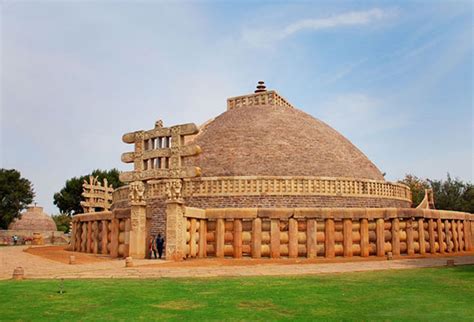
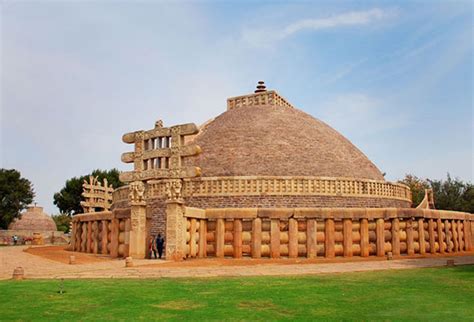
The Buddhist Monuments at Sanchi represent some of the finest examples of early Buddhist architecture in India. The centerpiece is the Great Stupa (Stupa 1), a hemispherical dome with a flattened top housing relics of the Buddha. The stupa stands 16.4 meters high with a diameter of 36.6 meters, making it one of the largest ancient stupas in India. Its massive size and perfect proportions demonstrate the remarkable engineering skills of ancient Indian architects.
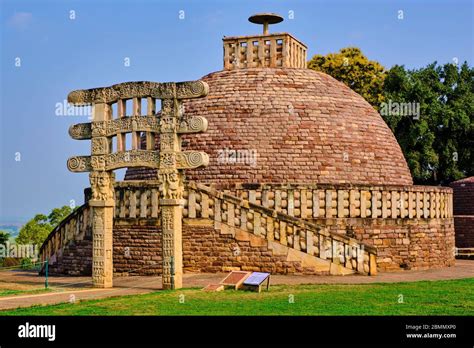
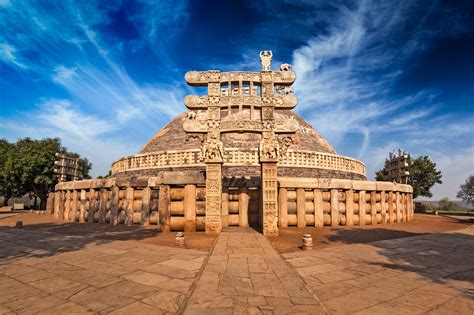
What truly sets Sanchi’s architecture apart are the four ornately carved gateways or toranas that were added during the Satavahana period. Each torana stands approximately 10 meters high and features elaborate carvings depicting scenes from Buddha’s life, Jataka tales, and other Buddhist narratives. These gateways face the four cardinal directions and are considered masterpieces of early Indian art, showcasing an incredible level of detail and artistic sophistication that has withstood over two millennia.
| Architectural Element | Description | Significance |
|---|---|---|
| Great Stupa (Stupa 1) | 16.4m high hemispherical dome | Main monument housing Buddha relics |
| Toranas (Gateways) | Four 10m high ornate entrances | Narrative sculptures depicting Buddhist stories |
| Harmika | Square railing on top of stupa | Represents Buddha’s seat of enlightenment |
| Medhi | Circumambulatory path around stupa | Allows ritual clockwise movement (pradakshina) |
| Vedika | Stone balustrade | Separates sacred space from secular |
| Chattra | Three-tiered umbrella on top | Symbolizes Buddha’s high spiritual status |
| Stupa 2 | Smaller stupa with simpler decoration | Houses relics of Buddha’s disciples |
| Stupa 3 | Medium-sized stupa with single torana | Contains relics of important Buddhist monks |
| Temple 17 | Gupta period flat-roofed temple | Earliest surviving Indian stone temple |
💎 The Great Stupa (Stupa 1)
The Great Stupa, also known as Stupa 1, is the principal monument at Sanchi and the focus of the entire complex. Originally built by Emperor Ashoka in the 3rd century BCE as a simple brick structure, it was later expanded and encased in stone during the Sunga period. The stupa’s dome represents the dome of heaven enclosing the earth, while its spire symbolizes the cosmic axis connecting heaven and earth.
The most striking feature of the Great Stupa is its harmony of proportions and symbolic elements. The hemispherical dome represents the Buddha’s bowl, overturned when he attained nirvana. Atop the dome sits the harmika, a square railing that represents the Buddha’s seat of enlightenment, crowned by a triple umbrella (chattra) symbolizing the Three Jewels of Buddhism: Buddha, Dharma, and Sangha. The entire structure is surrounded by a stone railing (vedika) with four intricately carved gateways (toranas).
🗿 The Four Toranas (Gateways)
The four gateways or toranas that surround the Great Stupa are perhaps the most celebrated artistic elements at Sanchi. Added during the 1st century BCE, each gateway faces one of the cardinal directions and consists of two square pillars supporting three curved architraves with a crowning element. The entire surface of these gateways is covered with magnificent reliefs depicting various Buddhist narratives.
What makes these toranas extraordinary is that they tell stories without depicting the Buddha in human form, as was the custom in early Buddhist art. Instead, the Buddha is represented through symbols such as the Bodhi tree, the Wheel of Law (Dharmachakra), footprints, or an empty throne. The scenes carved on these gateways provide invaluable insights into daily life, royal ceremonies, and religious practices of ancient India, making them not just artistic masterpieces but also important historical documents.
🏯 Temples and Monasteries
Beyond the stupas, Sanchi is home to several temples and monasteries that showcase the evolution of Buddhist architecture over centuries. Temple 17, dating from the Gupta period (5th century CE), is particularly significant as it represents one of the earliest examples of structural temple architecture in India. It features a flat-roofed sanctum with a portico supported by four pillars.
The monasteries (viharas) at Sanchi were living quarters for monks, arranged around central courtyards. These structures evolved from simple cells cut into rock to more elaborate multi-storied buildings. Archaeological remains show evidence of assembly halls, kitchens, and other communal facilities that supported a thriving monastic community. The layout of these monasteries influenced Buddhist architectural traditions across Asia, from Afghanistan to China and Japan.
🎨 Artistic Significance of Sanchi Carvings
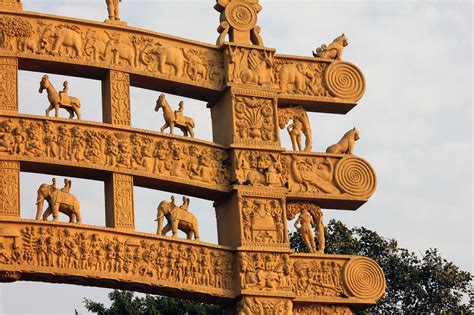
The artistic heritage of Sanchi represents one of the most important visual chronicles of ancient Indian culture. The carvings found throughout the complex, particularly on the toranas of the Great Stupa, showcase the development of early Indian art and its influence on Buddhist artistic traditions throughout Asia. These reliefs are executed with remarkable skill, bringing to life scenes from the Buddha’s life, his previous lives (Jataka tales), and important historical events.
What makes Sanchi’s art unique is its narrative style and attention to detail. The artists used a technique of continuous narration, where multiple episodes of a story unfold across a single panel. This dynamic storytelling approach, combined with naturalistic depictions of people, animals, and plants, creates scenes of extraordinary vitality that transport viewers to the ancient world. The carvings also reveal much about daily life, including clothing styles, musical instruments, architectural details, and social customs of the time.
| Artistic Element | Description | Notable Examples |
|---|---|---|
| Jataka Tales | Stories of Buddha’s previous lives | Mahakapi Jataka (Great Monkey King) on Eastern Gateway |
| Life of Buddha | Key events without human depiction of Buddha | Birth, Great Departure, Enlightenment scenes |
| Nature Motifs | Flora and fauna representations | Lotus blossoms, animals, mythical creatures |
| Yakshis | Female nature spirits | Salabhanjika (tree goddess) figures on gateways |
| Narrative Panels | Sequential storytelling within panels | Processions, royal visits, worship scenes |
| Symbols | Aniconic representations of Buddha | Bodhi tree, empty throne, footprints, wheel |
| Royal Imagery | Court scenes and imperial processions | Ashoka’s visit to the Bodhi tree |
| Daily Life | Ordinary activities and social customs | Market scenes, village life, entertainment |
| Architectural Details | Buildings and urban settings | Palaces, homes, and city landscapes |
🖼️ Narrative Relief Sculptures
The relief sculptures at Sanchi are remarkable for their narrative complexity and visual storytelling techniques. Unlike later Buddhist art where the Buddha is depicted in human form, the Sanchi artists adhered to an aniconic tradition, representing the Buddha through symbols. This creative constraint led to innovative compositional strategies that focused on the events surrounding the Buddha rather than the figure himself.
Among the most famous narrative scenes are the depictions of Emperor Ashoka’s visit to the Bodhi tree at Bodh Gaya, the removal of Buddha’s relics from their original eight stupas, and the transportation of a Bodhi tree sapling to Sri Lanka. These historical events are interwoven with mythological stories and Jataka tales, creating a comprehensive visual encyclopedia of early Buddhist traditions and beliefs that continues to provide scholars with invaluable information about this period.
🧍 Depictions of Daily Life and Society
Beyond religious narratives, the Sanchi carvings offer a fascinating glimpse into everyday life in ancient India. The artists depicted detailed scenes of urban and rural life, including royal processions, musical performances, marketplace activities, agricultural practices, and domestic scenes. These representations provide archaeologists and historians with crucial evidence about architecture, transportation, clothing, jewelry, weapons, and even hairstyles of people from various social classes.
The carvings also illustrate the social dynamics of the period, showing interactions between different communities, gender roles, and religious practices. We see traders with foreign features suggesting international connections, women participating in religious ceremonies, and people from various walks of life engaged in worship. These scenes paint a picture of a cosmopolitan society with complex social structures and cultural exchanges that extended beyond the Indian subcontinent.
🌿 Symbolism and Iconography
The art of Sanchi is rich in symbolism, using a sophisticated visual language to communicate Buddhist concepts and stories. Common symbols include the lotus (representing purity and enlightenment), the wheel (dharma or teaching), the Bodhi tree (enlightenment), lion (royal authority), elephant (conception of the Buddha), and the stupa itself (Buddha’s parinirvana or final release).
These symbols were not merely decorative but served as mnemonic devices for pilgrims and monks, reminding them of key Buddhist teachings. The arrangement of these symbols often follows specific patterns that relate to cosmological concepts in Buddhist philosophy. For example, the four gateways correspond to the four noble truths, while the circular path around the stupa represents the cycle of rebirth that the Buddhist practitioner seeks to transcend.
🌏 Global Significance and UNESCO Recognition
The Buddhist Monuments at Sanchi achieved global recognition when UNESCO declared them a World Heritage Site in 1989. This prestigious designation acknowledges their outstanding universal value as one of the most well-preserved ancient Buddhist sanctuaries and an important testimony to the spread of Buddhism across Asia. The UNESCO citation specifically mentions the artistic and architectural innovation evident at Sanchi and its importance as a center of Buddhist learning for nearly fifteen centuries.
The global significance of Sanchi extends beyond its architectural and artistic merits. As one of Emperor Ashoka’s projects to spread Buddhist teachings, Sanchi represents a pivotal moment in world history when Buddhism began its transformation from a regional Indian philosophy into a global religion. The monuments bear witness to this important cultural exchange that would eventually influence civilizations across Asia and later the world.
| Aspect | Global Impact | Current Status |
|---|---|---|
| UNESCO Recognition | World Heritage Site since 1989 | Actively protected and preserved |
| Archaeological Importance | One of best-preserved ancient Buddhist sites | Ongoing research and excavations |
| Tourism Impact | Attracts visitors from over 50 countries | Approximately 100,000+ visitors annually |
| Cultural Diplomacy | Symbol of India’s Buddhist heritage connections | Featured in international exhibitions |
| Conservation Efforts | Model for heritage preservation | Collaborative international projects |
| Educational Value | Research center for Buddhist studies | Regular academic conferences and publications |
| Spiritual Significance | Active pilgrimage site | Visited by Buddhist practitioners worldwide |
| Cultural Identity | Pride of Indian national heritage | Featured on Indian currency and stamps |
| Archaeological Techniques | Pioneered restoration methodologies | Training ground for conservation experts |
🔍 Archaeological Discoveries and Research
Sanchi continues to be an important site for archaeological research, yielding new discoveries that enhance our understanding of ancient Indian civilization. Since its rediscovery in 1818 by British General Taylor, numerous archaeological expeditions have unearthed artifacts, inscriptions, and architectural elements that provide insights into the site’s development over centuries. Sir John Marshall’s extensive work between 1912 and 1919 established the chronology of the monuments and secured their preservation for future generations.
Recent archaeological investigations using advanced technologies such as ground-penetrating radar, 3D scanning, and satellite imagery have revealed previously unknown structures buried beneath the surface. These discoveries suggest that the Sanchi complex was even larger than previously thought, with extensive residential areas and possibly educational facilities. The ongoing research at Sanchi continues to refine our understanding of how this sacred center evolved and functioned as a hub of Buddhist learning and practice.
🧘♀️ Spiritual and Religious Importance
Despite centuries of abandonment, Sanchi has reclaimed its place as an important spiritual center for Buddhists worldwide. Today, pilgrims from countries with significant Buddhist populations—including Sri Lanka, Thailand, Japan, Tibet, and Myanmar—regularly visit Sanchi to pay homage to this ancient seat of Buddhist wisdom. The site hosts several annual ceremonies, including Buddha Purnima celebrations that attract thousands of devotees.
The revival of Sanchi as a living religious center began in the early 20th century, coinciding with the Buddhist revival movement in India and the growing interest in Buddhism internationally. In 1952, relics believed to be those of the Buddha’s chief disciples, Sariputta and Maha Moggallana, were returned to Sanchi from British museums and ceremonially enshrined in Stupa 3. This event symbolized both the spiritual reawakening of the site and India’s reclamation of its Buddhist heritage after independence.
🛡️ Conservation Challenges and Efforts
Preserving the Buddhist Monuments at Sanchi presents unique challenges due to their age, construction materials, and environmental factors. The Archaeological Survey of India (ASI) maintains ongoing conservation programs that balance preserving the authentic character of the monuments while protecting them from deterioration. These efforts include monitoring structural stability, controlling biological growth, documenting carvings with digital technology, and carefully planning tourism infrastructure to minimize impact on the ancient structures.
International collaboration has been crucial in conservation efforts at Sanchi. Organizations such as UNESCO, the Japan Bank for International Cooperation, and various academic institutions have provided expertise and funding for specialized conservation projects. These partnerships have led to the development of innovative techniques for stone conservation, drainage management, and visitor control that help ensure Sanchi’s preservation for future generations while making it accessible to present-day visitors.
📚 Educational Value and Tourism
The Buddhist Monuments at Sanchi serve as an invaluable educational resource, offering insights into ancient Indian history, art, architecture, and religious practices. The site functions as an open-air classroom where visitors can learn about the evolution of Buddhism, the reign of Emperor Ashoka, and the cultural exchanges that shaped Asian civilizations. The recently established Sanchi University of Buddhist-Indic Studies further enhances the educational significance of the area by providing specialized academic programs in Buddhist philosophy, art, and archaeology.
Tourism to Sanchi has grown steadily in recent decades, with visitors from across India and around the world making the journey to this sacred site. The Indian government and local authorities have developed infrastructure to accommodate this growing interest while striving to maintain the spiritual atmosphere and historical integrity of the monuments. This balance between accessibility and preservation represents one of the key challenges in managing World Heritage Sites in the 21st century.
| Visitor Information | Details | Recommendations |
|---|---|---|
| Best Time to Visit | October to March | Avoid monsoon season (June-September) |
| Opening Hours | 6:30 AM to 6:30 PM daily | Early morning for best photography |
| Entry Fee | ₹40 for Indians, ₹600 for foreigners | Free for children under 15 |
| Nearest Airport | Raja Bhoj Airport, Bhopal (46 km) | Taxi services available to Sanchi |
| Nearest Railway Station | Sanchi Railway Station (2 km) | Well-connected to major cities |
| Accommodation | Limited options in Sanchi, more in Vidisha/Bhopal | Advanced booking recommended |
| Guided Tours | Available in multiple languages | Recommended for detailed understanding |
| Photography | Allowed (no tripods without permission) | Early morning light best for carvings |
| Visitor Facilities | Museum, rest areas, cafeteria | Limited facilities, carry essentials |
🏫 Museum and Interpretation Center
Complementing the monument complex is the Sanchi Archaeological Museum, established in 1919, which houses artifacts discovered during excavations that cannot remain in situ. The museum’s collection includes architectural fragments, sculptures, pottery, tools, and coins that provide a more comprehensive understanding of Sanchi’s historical and cultural context. Particularly noteworthy is the museum’s Ashoka Pillar capital, featuring the famous four lions that became the emblem of the Republic of India.
In recent years, a modern interpretation center has been added to enhance the visitor experience through interactive displays, scale models, and audio-visual presentations. These facilities help visitors understand the complex symbolism of Buddhist art and the historical significance of the monuments before exploring the actual site. Educational programs for students of different age groups are regularly conducted, making Sanchi an important destination for school excursions and university field trips focused on Indian history and cultural heritage.
🌐 Digital Preservation and Virtual Access
Recognizing the importance of both preserving and sharing Sanchi’s heritage, various digital documentation projects have been undertaken in recent years. High-resolution 3D scanning of the monuments and their carvings has created detailed digital archives that serve multiple purposes: they provide precise documentation for conservation work, create research resources for scholars unable to visit the site, and offer virtual access to people around the world.
Several online platforms now offer virtual tours of Sanchi, allowing global audiences to explore the monuments remotely. These digital resources have become particularly valuable for educational purposes, enabling students worldwide to study this UNESCO World Heritage Site without physical travel. The COVID-19 pandemic accelerated the development of these virtual access options, highlighting their importance for cultural heritage accessibility in the 21st century.
👥 Community Engagement and Sustainable Tourism
The management of Sanchi as a heritage site increasingly emphasizes engagement with local communities and sustainable tourism practices. Local residents are trained as guides and craftspeople, creating economic opportunities while ensuring authentic cultural interpretation. Traditional crafts inspired by Sanchi’s artistic motifs are promoted through workshops and marketplaces, helping preserve traditional skills while providing livelihoods.
Sustainable tourism initiatives include improved waste management systems, water conservation measures, and renewable energy installations that reduce the environmental impact of tourism activities. Visitor management strategies, such as timed entry tickets and designated pathways, help distribute visitor pressure and protect vulnerable areas of the site. These approaches recognize that Sanchi’s long-term preservation depends not just on physical conservation but on creating a sustainable relationship between the monuments, visitors, and local communities.
🔄 Legacy and Continuing Influence
The legacy of the Buddhist Monuments at Sanchi extends far beyond their physical presence in central India. Their artistic and architectural innovations influenced Buddhist art throughout Asia, establishing visual traditions that would evolve across different cultures but retain core elements first developed at sites like Sanchi. The narrative techniques and symbolic language created here provided a template for Buddhist art from Afghanistan to Japan, making Sanchi a crucial link in the transmission of both Buddhist doctrine and artistic expression.
In modern India, Sanchi has become an important symbol of the nation’s ancient Buddhist heritage and its historical connections with other Asian civilizations. The four-lion capital from Sanchi’s Ashoka Pillar was adopted as India’s national emblem after independence, appearing on government documents, currency, and as a symbol of state authority. This appropriation of Sanchi’s imagery highlights its significance not just as a religious site but as a source of national identity and cultural pride.
| Influence Area | Examples | Significance |
|---|---|---|
| Architectural Influence | Stupa designs across Asia | Provided template for Buddhist sacred architecture |
| Artistic Traditions | Narrative relief sculpture techniques | Established visual storytelling in Buddhist art |
| National Identity | Four lions as India’s national emblem | Symbol of sovereign authority and cultural heritage |
| International Relations | Buddhist diplomacy with Asian nations | Cultural bridge between India and Buddhist countries |
| Modern Architecture | Contemporary buildings inspired by Sanchi | Influence on post-independence Indian architecture |
| Literary Inspirations | Poems, novels, and academic works | Continuing source of creative and scholarly inspiration |
| Film and Media | Documentaries and digital recreations | Popularization of Sanchi’s heritage globally |
| Tourism Development | Model for heritage site management | Influences approaches to other archaeological sites |
| Conservation Techniques | Stone preservation methodologies | Pioneered approaches used at other monuments |
🌉 Cultural Bridge Between Nations
Sanchi has emerged as an important element in India’s cultural diplomacy, particularly with nations that share a Buddhist heritage. High-level diplomatic visits to Sanchi from leaders of countries like Japan, Sri Lanka, Thailand, and Myanmar highlight its role as a symbol of shared cultural connections. The site frequently hosts international Buddhist conferences and ceremonies that bring together practitioners from diverse traditions, serving as a meeting point for the global Buddhist community.
These cultural connections have translated into practical cooperation for heritage preservation, with several international projects supporting conservation work at Sanchi. Japanese organizations have been particularly active in funding restoration efforts, reflecting the deep respect for Sanchi in Japanese Buddhist traditions. This international collaboration demonstrates how ancient cultural monuments can foster contemporary diplomatic relationships and mutual understanding between nations.
🏛️ Influence on Contemporary Architecture and Design
The elegant proportions and symbolic elements of Sanchi’s architecture continue to inspire contemporary designers and architects. The clean geometric forms of the stupas, the narrative approach to decorative elements, and the integration of natural motifs have influenced modern Indian architecture, particularly in the design of cultural institutions, memorials, and public buildings. Notable examples include elements of the Indian Parliament complex and various state museums that reference Sanchi’s architectural vocabulary.
Beyond architecture, Sanchi’s artistic motifs appear in contemporary Indian design, from textile patterns to jewelry, furniture, and graphic arts. The distinctive gateway designs, lotus medallions, and narrative bands have been reinterpreted in modern contexts, creating a visual continuity between ancient artistic traditions and contemporary creative expression. This ongoing influence demonstrates how Sanchi remains not just a historical monument but a living source of inspiration for new generations of artists and designers.
📈 Future Prospects and Development Plans
Looking to the future, Sanchi faces both opportunities and challenges. Development plans include enhancing visitor facilities, improving transportation connections, and expanding educational programs while ensuring these additions don’t compromise the site’s integrity or spiritual atmosphere. The recent establishment of Sanchi as a smart heritage city pilot project aims to integrate digital technologies for better site management, visitor experience, and conservation monitoring.
Research at Sanchi continues to yield new insights, with ongoing archaeological investigations using non-invasive technologies to map buried structures and understand the broader settlement patterns around the monuments. Academic partnerships with universities worldwide support specialized studies on Sanchi’s art, architecture, and historical context, ensuring that our understanding of this remarkable site continues to deepen even after two centuries of formal study.
🧠 Conclusion: Sanchi’s Enduring Significance
The Buddhist Monuments at Sanchi stand as eloquent testimonies to India’s rich cultural heritage and the universal values embodied in Buddhist philosophy. From Emperor Ashoka’s vision of peaceful propagation of dharma to the artistic masterpieces created by skilled craftspeople over centuries, Sanchi represents human creativity, spiritual aspiration, and cultural exchange at their finest. As a UNESCO World Heritage Site, it belongs not just to India but to all humanity as a shared treasure that connects us to our past and offers inspiration for our future.
For visitors today, Sanchi provides a rare opportunity to step back in time and experience the spiritual and artistic achievements of ancient India. The monuments continue to fulfill their original purpose as places of contemplation and learning, where people can reflect on Buddhist teachings and the historical conditions that shaped them. In our rapidly changing world, such places of historical continuity and spiritual depth become increasingly precious, reminding us of the enduring human quest for meaning and the power of art to communicate across centuries.
Keywords: Buddhist monuments Sanchi, Sanchi Stupa history, Buddhist architecture India, Emperor Ashoka Buddhism, UNESCO World Heritage Sites India
Internal Linking Opportunities:
- Learn more about Emperor Ashoka’s conversion to Buddhism
- Explore details of the artistic carvings and their meanings
- Plan your visit with our tourism information guide
External Reference: Buddhist Monuments at Sanchi – UNESCO World Heritage Centre
Interesting read. I bookmarked this for future reference. [XQ7T9]
The history and preservation of these monuments is truly incredible. I was just reading about similar ancient architectural techniques on https://kablora.com, which really helped me appreciate the scale of Ashoka’s legacy even more. Thanks for sharing such a detailed look at this UNESCO site!